
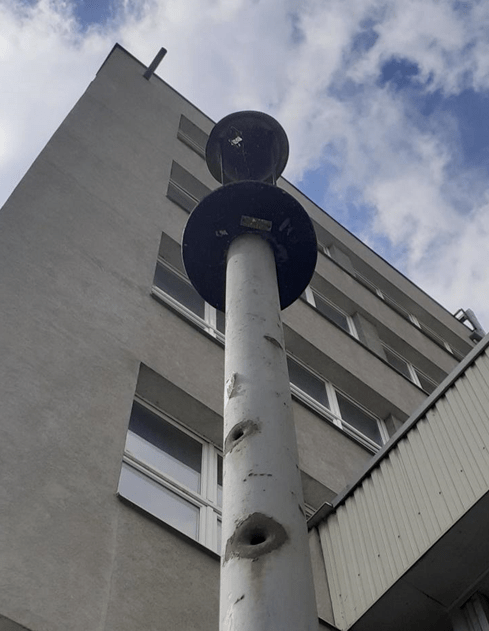
Throughout the interviews for the “Sound Lifeline” project, when the witnesses were asked about the soundscape of war, silence stands out as the most prominent sonic memory. In fact, silence also amplified the awareness of the absence of daily life processes. Silence is therefore conceptualized as a “basic tone” that aesthetically separates and emphasizes each individual sound and allows it to exist as its own entity within this electro-acoustic composition.
Like most sensorial experiences, the interpretation of sound is individual. Likewise, “Symphony of the Siege” was created with the desire to portray the relationship of individualizing collective experience and collectivizing individual experiences (in this case the siege) through the medium of acoustics, whereby the sound itself functions as a document of acoustic reality.
The aim of this electro-acoustic piece is to question the relationship between the collective and the individual war experience, between silence and sound, between memory and space, by acoustically recreating the individual sound memories of the witnesses and arranging them into a new composition. The piece allows to the listener to experience the reconstructed sounds of the siege, based on the fifteen testaments of the witnesses interviewed for the project.
Acts
“Symphony of the Siege’ consists of four acts: “Birth of the distance”, “Architecture of the ricochet”, “Abstractions of resistance” and “Calibrating of the silence”. The symphony opens with the sound of breaking the sound barrier above Sarajevo, which according to most of the witnesses triggers the first memory of the siege. The acts are conceptually moving the soundstage from the large urban scale in the first act right down to the most intimate scale in the last act.
Sound parameters as markers of the spatial dimension of the siege change exponentially according to the Fibonacci sequence (which, due to the mathematics of exponentiality best illustrates the nature, form, and function of sound) permeates every element of the composition.
It does so within the substantive eclecticism of the organization of sound miniatures, – a concept constructed to question the physical dimension of space as a given – and to represent sound as the delimiter of the landscape of the siege, suggesting that space is limited and confining. As the composition continues, the circle of sound sources closes, and the shooting gets closer while simultaneously becoming more sporadic. Its intensity decreases while the volume increases, and everything ends symbolically on a very intimate scale, with one shot fired at Džemil Hodžić’s brother Amel who was killed by the sniper while playing outside of his house.
Sound Miniatures
The composition is interlaced with many symbolic aspects, thus number 44, which represents 44 months of the siege transposed to the acoustic illustration of the siege and its mathematical reflections. The whole piece is set to Largo of 44 beats per minute, which is set as a tempo that symbolizes the slow passage of time under the siege. Furthermore, as mentioned above, the 4 acts consist of 40 sound miniatures. Each of the 40 sound miniatures is treated as an individual sonic memory representing an entity into itself, bearing a poetic name with its own spatial, architectural, acoustic, tonal, and temporal identity in relation to the mathematics and poetics of the whole composition.
In the artistic conceptualization of the miniatures, the methods of understanding the elements of the aesthetics of electro-acoustic sound composition and its traditional interpretation (such as echo, reverberation, natural exponential diffusion, architectural reflections, noise definition, soundscape, distance, dynamics, center of gravity, source, beat, movement within the sound panoramas of the phantom sound, tonality) are taken into account by creating a new acoustic space within the gallery’s existing acoustic space, all based on narrated memories of our witnesses. Thus, configuring sound semiotics within the relationship of these spaces, as well as the duration of the whole in relation to its parts, is all part of the artistic conceptualization.
The Acoustic Stage
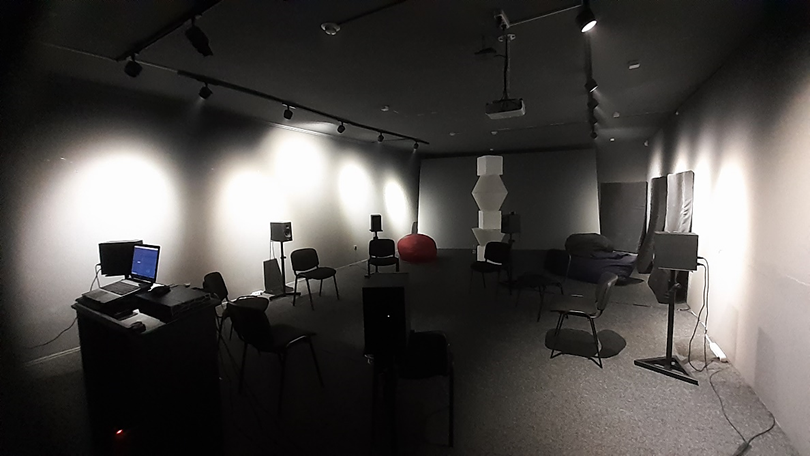
The piece’s installation consists of six audio monitors set up in a circular arrangement in a dark gallery. This placement creates a spatial reality for the performance; since the visitor cannot rely on their vision, their experience shifts to immersive listening. When describing the composition, we will refer to 12 corners of sound sources, like a clock, representing an acoustic spatial matrix. The duration of the entire “Symphony of the siege” is 547 seconds which, when divided within the 12 sound sources, forms the number 47. This is significant because every 47 seconds within the composition (including the duration of the silence), listeners hear gunshots from different weapons reproduced from a particular angle, which moves clockwise in the acoustics of the performance.
Rhythm
The rhythm of the first miniature within the first act, entitled “In the circle of time”, is conceptually permeating the entire duration of the piece. It represents a rhythmic backdrop within which all the other miniatures are in rhythmic syncopation.
In the first act, “Introducing the distance ‘’, the sound of gunshots sets the stage on the periphery of the city. The beat of this act is 4/4, and within the first second, 233 shots are heard – the position of the sound source is on the left channel of the monitor in the corner of 11 o’clock – the distance of the sound source is 14,400 m. As the composition progresses, the sounds of the shots get closer to the listener, indicating danger narrowing, in the 47th second, one can hear the 144 gunshots from the right channel monitor angled at 1 o’clock, at 8.900 m from the source, while in the 94th second, 89 gunshots can be heard from the left channel monitor, angled at 3 o’clock at the distance of 5.500 m from the source.
Continuing with the narrowing of the spatial distance, in the second act, “Architecture of the ricochet”, the sound of gunshots and other activities are set at the scale of the street. In this act the time signature is set to 3⁄4, and in the 140th second 55 gunshots can be heard from the position of the sound source from the angle of 4 o’clock, where the distance of the source is at 3,400 m.
In the third act, “Abstractions of the resistance”, the sounds of the siege take us down to the level of the common and residential spaces where the time signature shifts to 2/4. In the 282nd second, 13 shots can be heard, and the position of the monitor is at the angle of 7 o’clock while the distance of the source is 800m.
In the fourth and final act, “Calibration of the silence”, the sounds of the siege become those of the resistance to the violence and the time signature shifts further to 1⁄4. In the 570th second, we can hear one shot from the position of the monitor at the angle of 12 o’clock while the distance of the source is 100m.
~
Overture
~
INSIDE THE SOUND BARRIER
THE FISURATION OF THE ECCO
~
Act 1 – Birth of the distance
BPM: Largo 44 beats per minute
Tact: 4/4
~
IN THE CIRCLE OF TIME
RESISTANCE OF THE SPACE
STREET OF WALLS
PATH OF STEPS
TRAJECTORY OF THE LEAD
TREMOR OF THE ASPHALT
A KNOT IN THE AIR
RICOCHET OF THE DARKNESS
THE PRESSURE OF SILENCE
BREATH OF MOAN
BLADE OF FLAME
~
Act 2 – Architecture of the ricochet
BPM: Largo 44 beats per minute
Tact: 3⁄4
~
AT THE OCULUS OF CONSCIOUSNESS
WHIZ OF CONSCIENCE
FLAP OF WINGS
IN THE ROOM OF FREEDOM
A NOCTURNO
IN THE RAIN OF GLASS
IN A TACT OF FEAR
A DANCE OF THE LIGHT
~
Act 3 – Abstractions of the resistance
BPM: Largo 44 beats per minute
Tact: 2/4
~
CATARACTED FRAME
CORRIDORISTIA
NAGASAKI BLUES
AGGREGATE OF SILENCE
THE DYNAMICS OF LIFE
RADIO WARMTH
DIFFUSION OF TREE RINGS
EXODUS OF LEEDS
THE TORCH
DELITERALIZATION
HEARTHSTONE OF THE TRUTH
WITH HERTZ
WITHOUT FLOW
WITHOUT HERTZ
RHYTHM OF THE RAIN
~
Act 4 – Calibrating the silence
BPM: Largo 44 beats per minute
Tact: 1/4
~
AT THE CORNER OF THE CHILDHOOD
THE RESONANCE OF EVIL
PROTOCOL OF AGONY
AND FRIENDS FROM THE STREET
 [~]
[~] 